From antennas to applications: the true potential of 5G
Published on 11/05/2025 in Expert talks
5G is not just an upgrade from 4G, it marks a new era of mobile connectivity, IoT and cloud applications. But the real potential will only be realized when 5G becomes fully Standalone. What does this mean for your business?

Proximus customers have been enjoying higher data speeds since 2020 thanks to 5G. "The current service is in fact called 5G Non-Standalone, or 5G NSA for short. It uses enhanced 5G radio infrastructure, like antennas, but underlying it relies on a 4G core network. This hybrid setup leaves the true potential untapped," Van den Bosch, Product Manager 5G at Proximus NXT clarifies.
The core network is the heart of any mobile network. It allows mobile devices to connect to the network and data and voice services to be delivered efficiently. "5G NSA is available but the full-fledged 5G experience needs 5G StandAlone (SA) and that is still in the future. 5G SA requires adjustments both to the antennas and to the network. Proximus has been hard at work with that transition for several years."
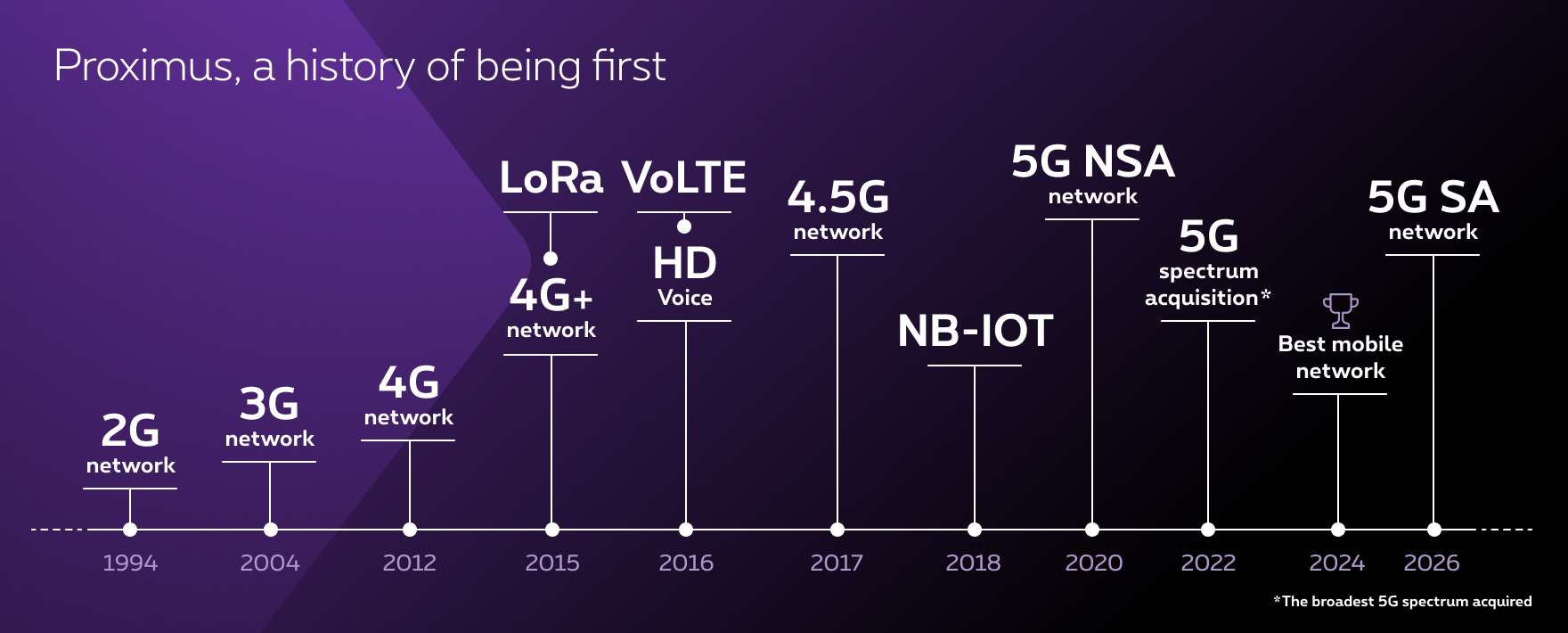
5G NSA significantly doubles the data rate compared to 4G (LTE), with speeds of up to 2 gigabits per second. Yet this upgrade is more of a transition phase than an end-point. Because, unlike the previous upgrades – from 2G to 4G – the true power of 5G SA is in the updated core network.
“That leads to a much more innovative scope, as the new service combines higher speed with low latency, state-of-the-art security, Voice over New Radio (VoNR) calling and network slicing.” The launch of 5G NSA was an intermediate step to provide customers with an enhanced service, while the true transformation is taking place behind the scenes.
Transition to 5G Standalone (SA)
Full support for 5G SA requires operators to go through a comprehensive program so that the network and antennas integrate seamlessly. "The rollout of 5G SA began with the auction by BIPT of the 5G frequency bands and the upgrade of the antennas. Around 70% of them have now been upgraded and we expect to finalize this by 2026," Rembert says.
"At the same time, we are rolling out a completely new 5G SA core with a distributed and cloud-native architecture. That places network functions closer to users, which translates into faster data processing and lower latency. This enables a wider range of applications."
Supporting IoT is a great example of this and that is already happening. Think about the use of drones in sports or what about 5G-connected sensors in logistics, manufacturing or industrial environments. The next step is the integration of 5G SA on smartphones. That offers faster communication between applications and cloud-based services, or for integrating an AI agent on the smartphone that delivers faster and more relevant input to the user. "This evolution is more complex because it requires smartphone manufacturers to do their share of the work. At the same time, they have strict privacy and security requirements."
Thanks to faster speed, lower latency and quantum-safe security, 5G SA allows more advanced applications on smartphones.
Rembert Van den Bosch, Product Manager 5G at Proximus NXT
Network slicing
The distributed 5G SA architecture brings new functionalities. One of the most important is network slicing. "This allows operators to create different virtual networks or slices on a single physical network. You then tailor such a slice to specific services, customers or even applications," Rembert explains. "Compare it to dividing a highway into different lanes and reserving each lane for a specific type of vehicle. In this process, each lane has its own traffic rules. At the end of 2023, we performed a successful proof of concept with slicing on a test 5G network ."
Slicing optimizes the performance of the mobile network and thus the experience of remote users for critical applications, such as real-time collaboration, quality videoconferencing and secure data transfer.
"For example, 5G slicing means that we can give emergency services priority on the network so that reliable and immediate access to the necessary information and communication channels can be guaranteed. We can also distinguish between private and professional applications on a smartphone, and differentiate routing and connectivity. In turn, the improved stability is great for video communication and augmented reality, which also offers its added value in a business context."
Quantum-safe
Where slicing supports data services on 5G SA, voice service must also evolve to a new technology, Voice over New Radio (VoNR). “Compared to the current voice service VoLTE (4G), a smartphone with VoNR always stays on the 5G SA data service, even during phone calls,” Rembert continues. “Over time, we expect VoNR to also further improve call quality and set-up time.”
In December 2024, Proximus, together with its network partners and with Google, demonstrated the first successful VoNR calls using a Pixel smartphone on the Belgian mobile network. Not only in a lab environment, but also on the operational network between our 5G hub at Fabriek Logistiek in Ghent and the Proximus office building in Brussels.
Moreover, to make 5G SA services futureproof, there will be a new SIM type, available in SIM and eSIM format. “This 5G SIM provides quantum-safe security to protect data traffic from attempts of quantum-computing de-encryption.” TUAK encryption – thanks to its larger and more complex algorithms – ensures user privacy and security, and protects companies from potential threats. “That 5G SIM is an absolute must for smartphone vendors to get on the cart.”
5G SA connectivity is an essential part of the data network of organizations.
Rembert Van den Bosch, Product Manager 5G at Proximus NXT
Data processing in real time
For IoT, the speed and low latency with which huge amounts of data are processed is crucial. "The new network really makes a leap forward in that. Today we already see companies using sensors to monitor devices or deploying drones for inventory management in warehouses," Rembert explains. "In the future, further automation will become possible, for example by using autonomous vehicles or robotics in industrial settings. Here privacy does not really play a role, but real-time data processing, higher security and the reliability of the mobile network make the difference."
5G SA can offer more
It is obvious that 5G SA has a lot going for it. This technology can also play a role within the so-called corporate walls. “For many companies, 5G SA offers a unique opportunity to strengthen their current data network,” Rembert continues. "It is not always possible to install a Wi-Fi network on large corporate sites because of cost or physical limitations, such as metal pipelines that give interference.
5G SA is then a cost-effective addition. It can work with existing networks and connectivity. Private 5G SA networks will also be part of this, which is of interest to the pharmaceutical industry and others."
Companies that want to remain efficient and competitive in a fast-changing digital world cannot ignore 5G SA. "Close interaction with the various smartphone suppliers is an absolute necessity for this transition. Only in this way will Proximus, together with its IT partners, succeed in guaranteeing the quality of current and future services."
How can 5G help your organization develop?
If your company is fully committed to digitization, remote working, IoT or smart applications, then 5G is an indispensable link in your infrastructure.
- 5G offers higher reliability of voice and data traffic.
- Lower latency is critical for applications with real-time monitoring or control.
- Slicing increases scalability and flexibility, and optimizes network performance.
- With quantum-safe security, your organization is resilient to future threats.
Curious about how 5G can help your business? We would be happy to show you.
Rembert Van den Bosch
Rembert Van den Bosch is Product Manager 5G at Proximus NXT. He develops services on public or private 5G networks. Rembert holds a Master’s degree in Bio Engineering, complemented by credentials in Business Administration and Strategic Account Management.