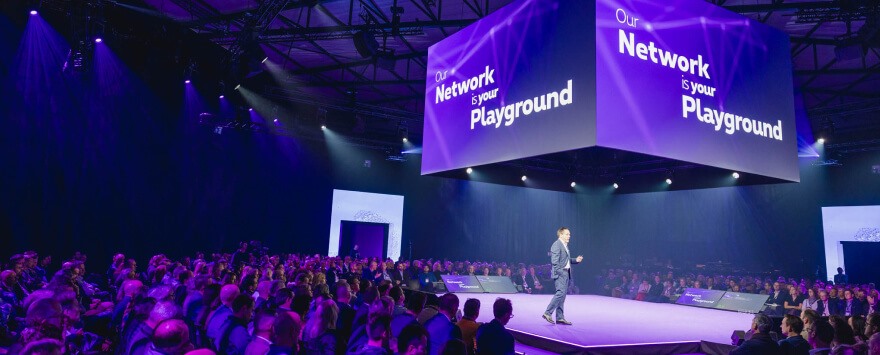
Think NXT 2025: five topics that will define the future of IT
Published on 11/12/2025 in Solution news
Technological evolution is accelerating continuously and increasingly shaping how organizations operate and innovate. Within this rapidly changing landscape, five themes are emerging that will define the future of IT. These were central to the Think NXT tech event.
Geopolitics is affecting the IT landscape
Two key topics that dominated last year will have a continued impact in 2026. First, there are geopolitical shifts that are creating uncertainty and tension. The IT world is no exception, and this has led to growing demand for sovereign solutions. Second, there is the impact of AI – from software development to process automation – across all IT fields: infrastructure, security, governance, ethics, and so on.
“Everything is changing,” says Koen Schoors, an economist at Ghent University. A major systemic change occurs roughly every 70 years. This was the case after the Second World War with the rise of globalization, and it’s happening again today. “The new world order will consist of loosely interconnected regional blocs. We talk about geopolitics, but it’s actually primarily egopolitics, centered around blocs like the US, Russia, and China.”
Everything is also improving, according to Schoors, thanks in part to AI, automation and robotization. If the working population continues to shrink due to population aging, we will soon be heavily reliant on this technology to maintain our standard of living.
Choosing the technology first is never the best idea. You have to start with a challenge
Ariane Berckmoes, Chief Digital & Transformation Officer at Ethias

Topic 1: Agentic AI
On average, the IT world shifts from a centralized to a distributed model – and back again – every 20 years or so. According to Stijn Bijnens, CEO of Proximus, we will soon be at the start of another such phase.
AI is increasingly being applied in practice through agentic AI. Stijn Bijnens, CEO of Proximus: “We won’t be working with complete apps any more, but with AI agents, each carrying out a small part of the whole.”
Granted, AI has been on the radar for a while. But there’s a big difference compared to one or two years ago. AI is in the midst of a transition from theory to practice, specifically through agentic AI: agents that perform actual tasks. “The potential is huge,” says Fabrice De Windt, acting CEO at Proximus NXT, “but we can only fully harness it if we also put in place the right governance, if we can trust the solution, and if we work ethically.”
At the same time, according to a now-infamous MIT study, 95% of all generative AI projects never get beyond the pilot stage. “Because businesses don’t think about the problem they want to solve,” says Ariane Berckmoes, Chief Digital & Transformation Officer at Ethias. “Choosing the technology first is never the best idea. You have to start with the challenge – and then come up with a suitable solution.” And that doesn’t necessarily have to be AI.
Transformation
“The real value of AI lies not so much in the technology itself as in the transformation,” says Jan Smedts, Head of Digitaal Vlaanderen. AI is here to stay, and it will have an impact. “So get ready for it and try it out.” The impact is already being felt today, including among the general public. “People aren’t searching for information on Google any longer,” says Jannes Labaere, CIO at Plopsa Group. “They ask ChatGPT to come up with ideas for a day at the beach. This is a development we need to respond to.”
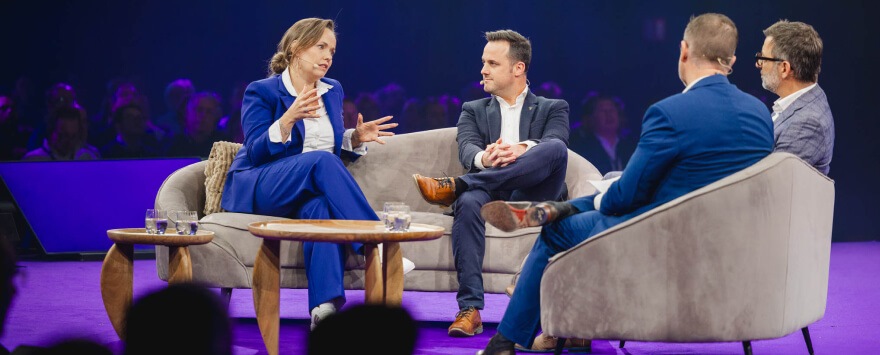
Retail is another sector where AI can make a difference. At the same time, the physical element – such as visiting a store – remains very important. “While it’s true that online tools can inspire customers,” says Pierre Delmarcelle, Logistics Warehouse Manager at Eggo Kitchen & House, “afterwards they still invariably come to the store to discuss their idea with an advisor and get a quote. AI can’t replace this process – it can help.”
In the banking sector AI’s impact is far greater. “We’re convinced that AI is fundamentally changing customer behavior,” says Anthony Belpaire, Head of AI at BNP Paribas Fortis. “Agentic AI is transforming the way we interact with customers. It makes us more accessible. But the concept of banking essentially remains unchanged: it had already existed for a long time even before the advent of electricity.”
Topic 2: cloud and edge computing
The hybrid cloud is now a reality. Businesses want to be able to choose the right environment for each specific workload. Agricultural cooperative SCAM (Société Coopérative Agricole de la Meuse) has migrated to the public cloud with Proximus NXT. “It enables us to provide more and better support, for example to our sales teams,” says CIO Lionel Van Dongen. “We’re looking for greater efficiency, including with AI, but also for applications to offer our members extra services.”
In the context of cloud computing, the edge is becoming increasingly important, for example, in manufacturing companies or healthcare, where computing power is needed very close to the action. At the same time, the need for stricter data governance is growing. For instance, increasing attention is being paid to European security and compliance standards. Calls for digital sovereignty are therefore growing louder.
“Anticipating is always cheaper than reacting,” Jan Smedts comments (Digitaal Vlaanderen). “Fear and hope aren’t good strategies. It’s important to think today about the potential impact of a lack of sovereignty on your business. At the same time, you can’t simply achieve sovereignty overnight. You need to develop a roadmap.”




European alternative
The first specialized initiatives have now appeared on the market to meet the demand for sovereignty. For example, there is Clarence, a joint venture of Proximus Luxembourg and LuxConnect—a connectivity initiative of the Luxembourg government. Clarence manages infrastructure that’s based on Google technology but isn’t connected to a public platform in any way. “Only the customer has access to the data,” says Joris Duysens, Cloud Solution Sales Lead at Proximus NXT. “The solution is fully air-gapped and intended for data that isn’t suitable for the public cloud.”
The fact that a solution like the one provided by Clarence is needed is a reality check for many companies. It makes us stop to consider the origins of the technology we use today. “About 80% of the technology we use in Europe comes from outside Europe,” says Paul Timmers, visiting professor at the Public Governance Institute (KU Leuven). “There’s a need for a European alternative. Not out of a protectionist mindset, but to create more freedom of choice and less dependency.”
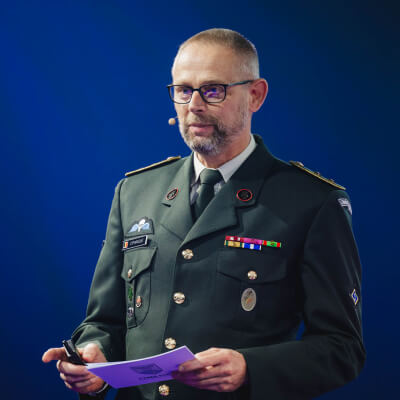
"Cybersecurity isn’t just about technology; it’s also a matter of teamwork. Unity is our most important weapon"
Major General Pierre Ciparisse, Commander of the Belgian Cyber Force
Topic 3: cybersecurity and cyber resilience
Reports of cyber incidents continue to dominate the news. The number of threats is growing, but the nature of the attacks is also changing all the time. “This affects our views on security,” says Fabrice De Windt. It’s no longer something you bolt onto your IT environment as an afterthought. “You need to build in resilience from the start and throughout the entire chain: secure systems, secure processes, and users who are aware of the risks.”
The importance of this is obvious for manufacturers. “Our factories operate around the clock,” says Koen Vereeken, Global IT Lead Infrastructure & Operations at Bekaert. “Downtime is something we definitely want to avoid.” Bekaert is doing this by working with Proximus NXT on monitoring and automation, with the corresponding support, around the clock. “We’ve developed a collaborative model based on right-shoring: a smart combination of local expertise and global support.”
Unity as a weapon
Extra attention is being paid – especially since the invasion of Ukraine – to the cyber threats resulting from the changing geopolitical situation. “Belgium as a country isn’t at war,” says Major General Pierre Ciparisse, Commander of the Belgian Cyber Force, “but there isn’t real peace either.” Among other things, Ciparisse points to cyber attacks on government institutions and critical infrastructure, and the recent incidents involving drones.
“It’s a form of hybrid warfare, where it’s not always clear who is behind it, but what is clear is the impact: on infrastructure, IT and people.” The Major General’s advice is clear. “Cybersecurity isn’t just about technology; it’s also a matter of teamwork. Unity is our most important weapon.”
“In the context of cybersecurity, the main thing is to take action,” says Stephan Van Dyck, Enterprise Security Architect at Proximus NXT. “When we analyze an incident at a company, we usually find that the cause isn’t lack of people or resources. Very often, there’s been a lack of action: a problem was known, but the solution got bogged down in an endless series of meetings.”




Action
To mitigate a risk, there comes a point when you simply have to take concrete action. At the same time, you have to do this intelligently. “You have to strike the right balance,” says Jérémy Grandclaudon, Senior Cybersecurity Expert at the Agence du Numérique (AdN). “It’s all about the combination of speed, the right level, and the desired impact. You can’t do everything at once, but by making the right choices, you can still make optimal progress.
Topic 4: containerization
Containers are changing the way we build and deploy technology. They make it possible to develop, deploy, and scale up applications rapidly thanks to standardized packaging. At the same time, the use of containers requires robust infrastructure and even closer integration.
Containers allow computing power – especially in combination with 5G – to be brought to anywhere in the network. This has advantages: low latency, greater resilience to security incidents and control over the location of data. Again, this last advantage is important in the context of sovereign solutions.
It also shows how containers are helping Proximus NXT evolve its role. “Our network is your computer,” says Stijn Bijnens. “Or even better: our network is your playground.” Containers help broaden Proximus NXT’s role. “Not just as a provider of connectivity on which other companies deliver services, but as a partner for local cloud services, security, and related services.”

"Regulation provides greater visibility, which effectively leads to more collaboration and action"
Jehan Snyers d’Attenhoven, Global Infrastructure Director at FN Browning Group
Topic 5: working in complex ecosystems
More than ever before, technology is teamwork. IT’s success depends on how people, processes, and platforms collaborate, within both the organization itself and a wider ecosystem. The logistics sector is a prime example of this. “With the Inbound Release Platform, we’ve developed a new, digital customs declaration platform,” says Geert Lambrechts, project manager at NxtPort. This required close collaboration to get all terminals, agencies, and other service providers in the Port of Antwerp-Bruges behind the project.
Many external factors such as increasing regulation and changing import and export tariffs are putting manufacturers under pressure. Technology can help provide the necessary agility and resilience. “It means that everyone has to have their basics in order,” says Jehan Snyers d’Attenhoven, Global Infrastructure Director at FN Browning Group. It requires collaboration across the ecosystem. Regulation can provide more clarity in this regard. “Regulation provides greater visibility, which effectively leads to more collaboration and action, including around security.”
Relive Think NXT 2025 and discover the themes that will shape the future of IT.