






Hybrid cloud for enterprises

Keep control of your data, without limiting your flexibility

  • Hosted in Belgium and Europe
  • End-to-end support from design to operations
  • Flexible hybrid cloud aligned with your needs

Why hybrid cloud matters

Your business needs to innovate faster, while keeping risk under control. At the same time, geopolitical uncertainty and stricter European regulations are raising the bar for security, compliance and data governance. Hybrid cloud helps organizations stay agile without compromising on control, resilience or sovereignty.

Hybrid cloud explained: what is it?

A hybrid cloud combines different cloud environments into one connected setup. It gives large companies and organizations the flexibility to run each workload where it performs best, while keeping full control over sensitive data and compliance requirements.

Benefits and use cases of a hybrid cloud

Business continuity

Keep critical services running, even during outages. Hybrid cloud supports resilient setups such as cloud bursting and failover.

Stronger resilience and backup

Reduce downtime and recover faster after incidents. Hybrid cloud helps you protect workloads with disaster recovery and secure backup strategies.

Compliance and data sovereignty

Keep sensitive data under control and align with regulatory requirements. Hybrid cloud lets you host critical workloads in private environments while still benefiting from public cloud innovation.

Cost optimization

Optimize cloud spend by placing workloads where they make most sense. Hybrid cloud helps you balance performance, risk and cost across environments.

Improved performance

Deliver better user experiences and application response times. Hybrid cloud lets you run workloads closer to users, systems and data when latency matters.

Agility and scalability

Respond faster to market changes and evolving demand. Hybrid cloud gives you the flexibility to scale resources up or down without overbuilding infrastructure.

Application modernization

Modernize legacy systems without disrupting daily operations. Hybrid cloud enables gradual migration and refactoring, with faster delivery of new digital services.

AI, IoT and edge computing

Support data-intensive use cases closer to where data is generated. Hybrid cloud helps you run AI and IoT workloads securely while keeping control over critical data flows.

Faster Dev/Test environments

Accelerate software delivery with on-demand environments. Hybrid cloud makes it easier to spin up, scale and retire test platforms when teams need them.

Your hybrid cloud roadmap

Every hybrid cloud journey is different. Our Proximus NXT experts guide you through each step, from strategy to day-to-day operations. Here's how we work:

Already using Microsoft Azure?

If Microsoft Azure is part of your current cloud setup, we help you integrate, migrate and manage it as part of a secure and scalable hybrid cloud environment.

As a Microsoft Azure Expert Managed Services Provider, Proximus NXT brings the certified expertise to support you end to end.

Why sovereignty matters in the cloud

Choosing the right hybrid cloud setup is only part of the story. As organizations adopt hybrid cloud, it becomes essential to retain control over data, operational processes, and infrastructure. That’s where sovereignty comes in. Proximus NXT helps you build a hybrid cloud setup that aligns with your business strategy while guaranteeing full sovereignty in three key areas:

Data sovereignty

Means your sensitive data stays in Belgium and is never accessible from outside the EU. This is crucial for sectors handling personal, regulated, or business-critical information.

Operational sovereignty

Means you stay in control of who manages and supports your cloud. Instead of relying on global providers, you work with trusted local partners like Proximus NXT, ensuring control, clarity and compliance at every step.

Technological sovereignty

Means you're not tied to a single vendor. Open, interoperable solutions let you choose what fits best, switch when needed, and stay flexible without losing control or compliance.

Whether you run workloads in a private cloud, an encrypted or disconnected public cloud, or across Azure, GCP or AWS in a multicloud setup, Proximus NXT makes sure your hybrid cloud is compliant, connected and fully sovereign. You get the scalability and agility of the public cloud, combined with the control and trust of local infrastructure.

Trusted by leading businesses and organizations

Companies are increasingly choosing a combination of clouds: public, private, on-prem and possibly public sovereign cloud.

Joris Duysens, Head of Solution Sales Cloud at Proximus NXT

Extend your hybrid cloud with the right capabilities

Hybrid cloud works best when security, data and connectivity are aligned. Proximus NXT helps you extend your cloud setup with additional expertise when needed.

Cybersecurity

Protect workloads, users and data across your hybrid cloud landscape.

Data & AI

Turn cloud data into insights and accelerate innovation with trusted AI services.

Connectivity (Fiber & 5G)

Connect users, sites and cloud environments with secure, resilient networks.

Frequently asked questions

Private cloud

The private cloud is the opposite of the public cloud. Here you use a fully protected cloud environment. A private cloud is especially suitable for business-critical applications. Hosting is possible via the infrastructure of your own company or in one of the Proximus NXT data centers.

Public cloud

A public cloud, such as Microsoft Azure, Google Cloud Platform (GCP) or Amazon Web Services (AWS), relies on a shared infrastructure, without you or your customers noticing it. You do not need your own hardware as your cloud provider guarantees maintenance and updates.
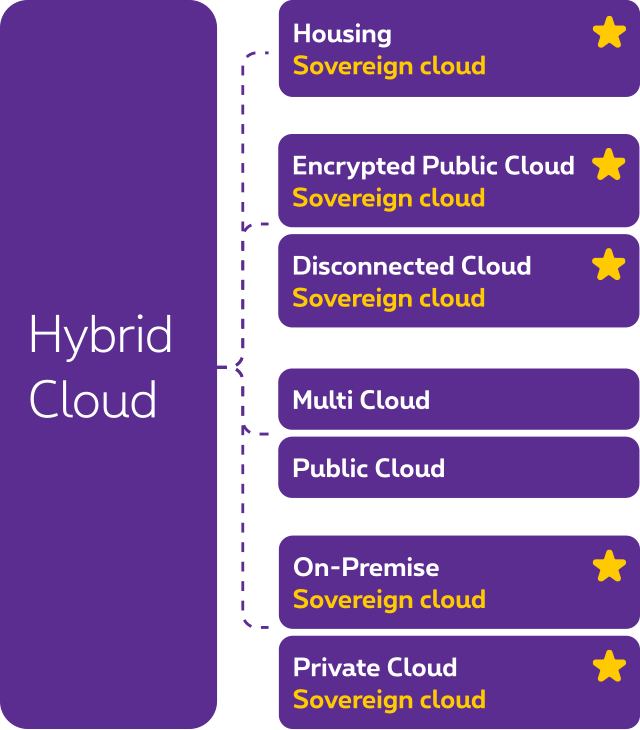
Hybrid cloud and multicloud are two flexible approaches to modern cloud architecture, but they work in different ways.

Hybrid cloud

  • Connects different environments into one orchestrated system.
  • Combines private and public cloud environments.
  • Can also integrate multiple private cloud setups, such as on-premises, housing, and the Proximus NXT Private Cloud.
  • Is ideal for running critical applications in a secure private cloud while handling less sensitive workloads in a scalable public cloud like Microsoft Azure.

Multicloud

  • Doesn't require environments to be directly connected, they simply coexist to serve different business needs.
  • Uses multiple public cloud providers side by side, such as Microsoft Azure, Google Cloud Platform (GCP), and Amazon Web Services (AWS).
  • Is part of a hybrid cloud setup, combining multiple public cloud providers with private or on-prem environments in a unified architecture.
  • Allows you to choose which cloud is used for each specific purpose or use case.

Common hybrid cloud migration challenges include application dependency complexity, data consistency and latency between on‑prem and cloud, security and compliance alignment across environments, network connectivity and performance issues, and operational readiness (skills, tooling, and processes). Organizations often underestimate cost management, downtime risks, and the effort needed to refactor legacy applications to fully benefit from hybrid cloud.

Hybrid cloud security risks typically stem from increased complexity and a larger attack surface. Common risks include inconsistent security controls across on‑prem and cloud, misconfigurations (especially identity, network, and storage), data exposure during movement between environments, and weaker visibility and monitoring across platforms. Additional challenges include identity and access management gaps, shared‑responsibility misunderstandings, and compliance drift when policies are not enforced uniformly.

Yes, hybrid cloud can be very safe when it is properly designed, secured, and operated. In many cases, it can be more secure than a single‑environment setup because organizations can keep sensitive workloads on‑prem while leveraging the cloud’s advanced security services.

Safety depends less on the model itself and more on how well security is implemented, including:

  • Consistent identity and access management across environments
  • Strong network segmentation and encryption (in transit and at rest)
  • Centralized monitoring, logging, and threat detection
  • Clear understanding of the shared responsibility model
  • Uniform security and compliance policies across on‑prem and cloud

When these controls are in place, hybrid clouds are widely used—and trusted—in regulated industries such as finance, healthcare, and government.

A hybrid cloud environment is not a one-size-fits-all concept. That is why it is important to elaborate a targeted cloud strategy in advance which is fully aligned with your business strategy. The success of your cloud migration will very much depend on how you define your goals, your current and future applications, and compliance requirements. Our certified experts will be happy to help you with this.

There are several use cases in the area of applications, operations, and corporate data where using a hybrid cloud environment can provide significant added value. One of the use cases is for companies that have to deal with peak and off-peak consumption in their work processes. If you have such a business, it is better to adopt a hybrid cloud model. This way, you do not have to provide increased capacity on a permanent basis.

The speed with which an IT infrastructure has to be scaled up also plays an important role. In a hybrid cloud model, you can then use a public cloud to supplement the available capacity of a private cloud, for example. Even if you have a company that wants or needs to keep part of its corporate data and applications in-house, a hybrid cloud model is still a good choice.